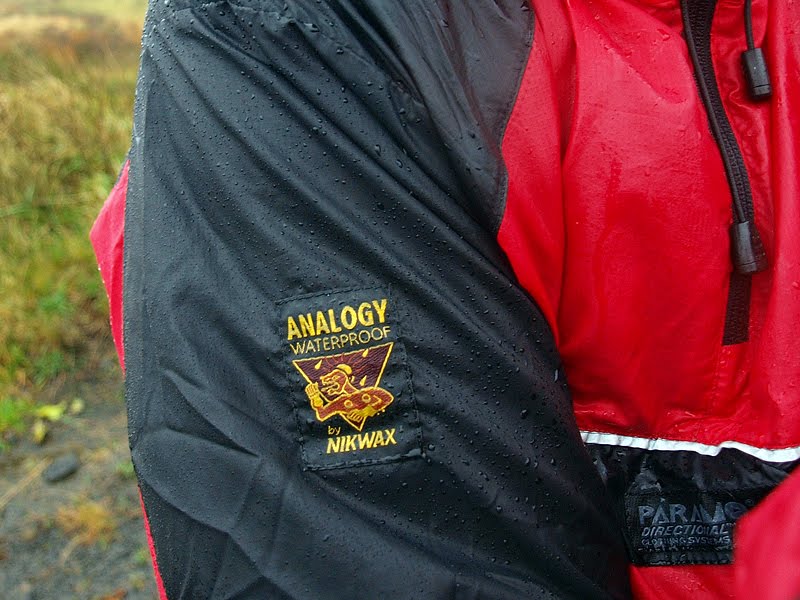
I wrote in relpy to some comments on a previous post about the paramo VAL that I had planned try it out by wearing it while out on my Mountain Bike. I had planned to do it last week as I thought I had booked it off as holidays. As it turned out I hadn't booked last week but had booked this week so everything was put on hold for a few days.
There aren't any proper mtb trails local to me and probably few in N.I. generally but there are a few forest tracks in some of the local F.S.N.I. plantations on the Antrim hills. I had a pretty good idea of where I wanted to go and using QUO mapping software I made out a route that started and finished at the Altnahinch reservoir.

The route followed the forestry tracks North Eastwards keeping Slievanorra on the left before exiting onto a short tarmac stretch. Re-entering the forest the route turned North West before swinging back South West towards the climb to the summit of Slievanorra with it's twin radio masts. Once the summit was gained it would be a fast descent back into the forest and an undulating cruise back to the start point at the reservoir. I decided to ride up to the start point as it's only about 9.5k from where I live.

I hadn't worn Paramo before and as some people suggest it's pretty warm I decided to just wear a Sub Zero F1 long sleeve baselayer underneath but also took a Uniqlo down jacket as an extra warm layer for stops. I wasn't sure about legwear but in the end wore my Mountain Equipment Ibex trousers over a pair of my old road bike club bibshorts. It didn't look as though there would be heavy rain so I didn't take over trousers as the ME Ibex are pretty good in light rain. I decided to simply wear a pair of windproof fleece gloves, a Polar Buff (under my cycle helmet) and a pair of knee length merino mix sock with my Trekmates Gore-Tex oversocks.
With my cooking gear, food, spare insulation, camera and bike related odds and ends packed into an Alpkit Goudron I set off at about 10.30. The sun wasn't shining but the skies weren't too overcast although there was a stiff South Easterly breeze. I soon started to heat up and unzipped the chest zip and both side vents on the VAL although I didn't feel uncomfortable even though my baselayer felt quite damp. By the time I'd made it the actual start point my baselayer started to feel dry so the Paramo had probably managed to wick the moisture away.
I hadn't gone far on the forest track when it started to rain, although it was light at first it started to increase, the wind soon picked up and the tops of the surrounding hills started to disappear, the radio masts on Slievanorra had been clearly visible when I'd started but as I caught glimpses of it through breaks in the trees summit was hidden in the low cloud.


I stopped a few times to take some photos and still felt comfortable, the VAL seemed to be keeping me dry and warm. I was starting to feel hungry but couldn't find anywhere that looked like it would provide much shelter and the rain was getting heavier and the wind picking up all the time.


I eventually reached the end of the trail and had to take to tarmac for about 1k before re-entering the forest for loop which would lead me to the climb to the summit of Slieveanorra. I was getting a bit fed up with it all as hunger was taking hold but eventually decided to pull off the track and take shelter behind a ruined building.

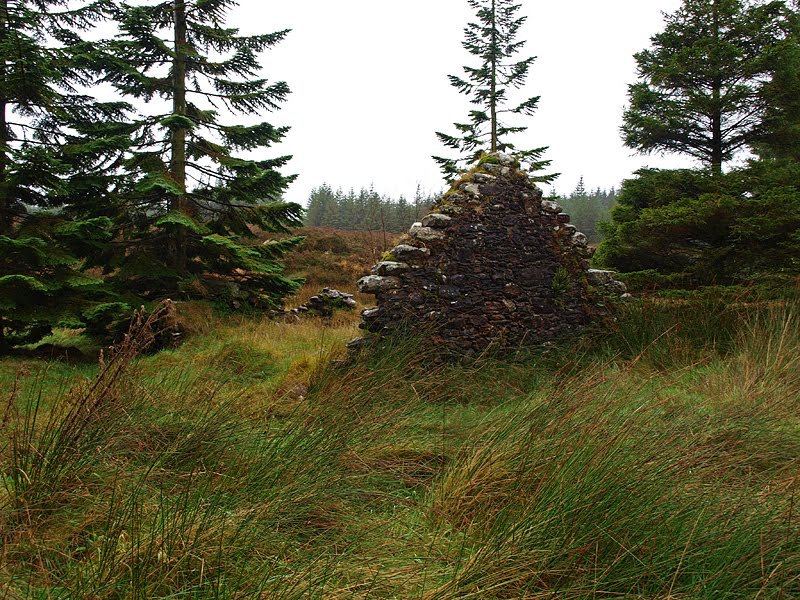

It was a pretty good spot, as although only part of the end wall was standing there was a large tree which helped provide some shelter and a stream just beyond from which to re-fill my water bottle. The ground however was really wet and I only had the small stiffened pad from the Alpkit Goudron to sit on, I'll have to replace it with something better, probably a rolled piece of closed cell foam.

I'd brought the GoSystem Fly ti and soon had it set up but almost failed to get it to light as both my lighters were low on gas and my hands were wet, my fleece gloves being long since saturated. In the end I managed to get it going and soon had about 500ml boiled.
I messed around trying to get a few photos but as I didn't want to start cooling down I pulled off the VAL, pulled on the Uniqlo down jacket and got the VAL back on again. I hadn't had a chance to try the hood prior to this as I'd been wearing a cycle helmet but the hood is really good, it tightens in well and has a traditional style peak/visor.

With a cuppa soup followed by a hot chocolate drink downed I packed everything up, removed the down jacket and hauled the bike back onto the track. Not having been out on the bike for ages my knees and calves were really burning but when I tried to stretch them out I could feel them cramping up, by this stage the Ibex trousers has just about given up any attempt at being water resistant.
When I reached the track leading to the summit of Slieveanorra I simply couldn't bike it and ended up pushing the bike most of the way only hopping back on for the flatter sections (I guess I'm just not fit enough)


The final 3-400m are completely exposed and the wind was really blowing hard, I could barely manage to walk let alone ride and had to keep the bike leaned over
as the wind was trying to swing it around and a 12 year old steel hardtail isn't lightweight by any means.

I was almost at the top before I could see the radio masts, probably less than 50m away. As soon as I reached the top I mounted up for the pretty fast descent, the track follows the fall line for quite a bit before entering the forest. In the end I couldn't see, my glasses were misting and the rain was being driven like hailstones so I couldn't manage without. I knew from being there before that the track was crossed regularly by drainage channels so kept the pace down as I simply couldn't see them until they were virtually under the front wheel, the channels aren't a problem if you can see them but I couln't and was having difficulty holding a line as the wind was pushing me all over the track. It was with some relief that I reached the trees again as they provided enough shelter and the rain didn't seem so bad. It was about that point that I felt as if water was getting through the VAL around the chest area, I checked that the neck zip was closed fully but then noticed that I hadn't studded the flap behind the zip, I closed the neck opening properly and to be honest didn't feel any ingress anywhere else although by now my feet were soaked as were my legs. I could feel rivulets running down my legs which was pretty unpleasant but no more unpleasant than my saturated fleece gloves and Polar Buff.
I'd arranged to be picked up at the reservoir and by this stage I was glad I had as another 9k didn't seem all that appealing. While waiting at the reservoir I noticed that the VAL had wetted out quite a bit but I didn't really notice any coldness.

Thoughts on the Velez Adventure Light

Once I arrived home I pulled off the VAL but noticed that my baselayer was a bit damp down the sides as well as the chest, turning the VAL inside out it felt quite damp between the side zips and the side seam especially near the armpits where the chest seam runs across, there was also a damp band all along the chest seam but strangely the seams running from shoulder to armpit were fine as were the seams on the arms. It's possible that the sternum strap of my rucksack forced water through at the chest seam but on the other hand the shoulder straps would likely have had the same effect on the shoulders. To be honest I think the side and neck zips let rain through and the single internal stormflap behind the zips isn't really good enough. That said I didn't feel wet although I was only wearing a baselayer and as I bought it as an alternative to Pertex/Pile I'm happy enough. It's swings and roundabouts I think and what you gain in one area you loose in another. It's definitely more comfortable than a regular laminated shell waterproof and feels warmer inside even when slightly damp, on the other hand I wouldn't like to claim it's waterproof, I'm pretty sure my Montane Venture wouldn't have allowed rain to penetrate in quite the same way.
I noticed that the care label says 'To enhance performance treat with Nikwax TX Direct for maximum water repellancy' I hope what it really means is that to maintain water repellancy treat with TX Direct, they wouldn't sell a waterproof jacket and expect you to treat it to make it more waterproof, surely it's either waterproof or it isn't? To be honest I don't really understand the 'Pump Liner' thing, it appears to suggest that the outer fabric isn't actually waterproof but relies on DWR to prevent ingress, the 'Pump Liner' absorbs moisture from your baselayer together with any water that has penetrated the outer fabric and pumps it back out. That may be incorrect but if not then I'd be a bit sceptical to be honest.
While I feel my Laminated shell jackets would have been better at keeping rain out I suspect that I'd have had more moisture on the inside, especially the arms which seems to be where I'll suffer most if I'm sweating a lot and been much less comfortable especially wearing only a baselayer.
I guess in the final analysis it's how it performs overall and whether it meets your expectations. I'm reasonably happy with the overall performance so far, I was able to wear it all day, in windy and dry conditions while sweating quite a bit, in wind and rain, heavy and wind driven at times when taking things easy and not generating much heat and all the time I was comfortable. Maybe that's what Paramo is about, I still haven't enough experience to know how it should perform, maybe it shouldn't allow water to soak through at the seams or zips, to be honest I'd prefer it if it didn't. Perhaps they normally are as waterproof as a fully taped laminate jacket, I simply don't know but I'll definitely be using it again although to be honest I'd be wary of using a down insulating layer. Something like the Montane Prism may be a better choice or dare I suggest a Paramo Torres smock which is designed as an extra insulating layer to be worn over something like the VAL.


